
Solamirian
'The People of the Sun Realm'
Overview
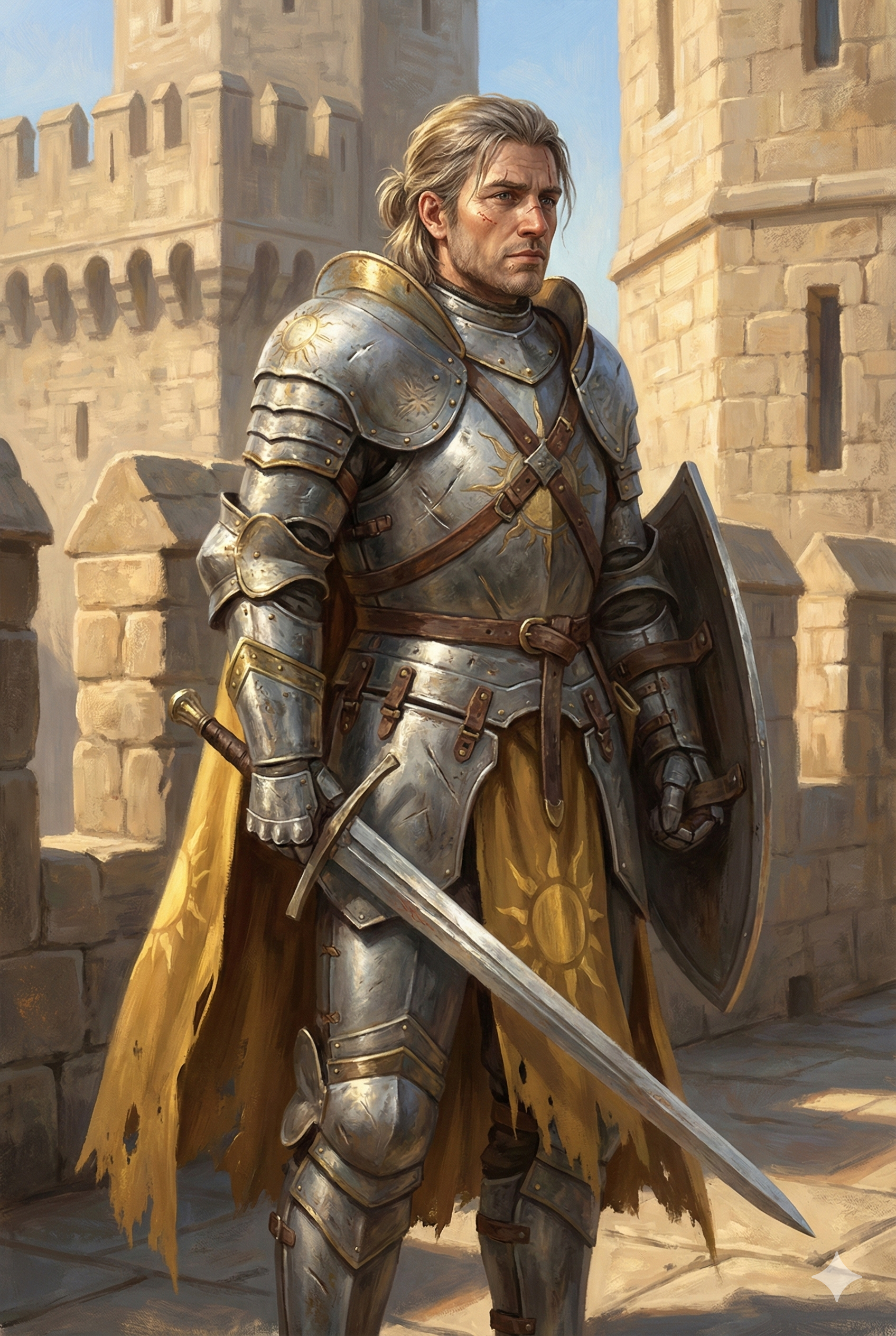
The Kingdom of Solamir stands among the great human realms of Athera, a land of fertile countryside, prosperous towns, fortified cities, and imposing castles. Known as the Sun Realm, its people take pride in a kingdom built upon centuries of labour, conquest, diplomacy, and sacrifice. The Solamirians are a people of diverse ancestry, descended from the ancient inhabitants of the western lands and those who migrated from the long-vanished civilisation of Everon. Over thousands of years, these populations mingled and became one, giving rise to a distinct people whose distant origins have largely faded from memory. Today, the Solamirians are united not by any particular bloodline, but by their shared homeland, language, customs, and allegiance to the Crown.
Solamir is a realm of established laws, hereditary nobility, and enduring institutions, where the Crown governs through a hierarchy of Dukes, Barons, and lesser authorities. Its strength rests not only upon its armies and fortifications, but upon the farmers, craftsmen, merchants, and labourers whose efforts sustain its settlements and trade. Scholars and scribes preserve the kingdom's records, while religious institutions provide spiritual guidance and charitable service throughout the realm. Honour, duty, and loyalty are widely respected virtues, though ambition, wealth, and political influence play no small part in Solamirian society. From the halls of the nobility to the crowded marketplaces of its towns, the lives of its people are shaped by both tradition and the opportunities of a prosperous, established kingdom.
Centuries of conflict have fostered a strong tradition of military service and vigilance, particularly along Solamir's contested borders. Its castles and fortified settlements stand as reminders that peace must often be defended, while its organised armies and noble households provide the means to do so. Yet the Solamirians are not a people defined by warfare alone. Their kingdom is equally renowned for its craftsmanship, commerce, learning, and religious traditions, and its people pursue lives as varied as those of any human realm. Though outsiders sometimes regard them as formal, proud, or overly concerned with rank, Solamirians are capable of great generosity, compassion, and personal ambition. Above all, they are a people who take pride in the kingdom they have built and the civilisation they continue to sustain.
Ethnonyms & Language
- Kingdom/Homeland: Solamir (the Sun Realm)
- Singular: Solamirian
- Plural: Solamirians
- Adjective: Solamirian
- Language: Solish
- Script: Solish-Script
Appearance
- Skin: Solamirians possess a wide range of complexions, from pale and fair to olive, tan, and darker shades. Skin tone varies considerably between individuals and families, reflecting the diverse ancestry of the kingdom's population. Those accustomed to outdoor labour, travel, or military service often develop weathered or sun-darkened complexions.
- Hair: Hair colours vary widely, including black, brown, blond, red, and the many shades between. Hair may be straight, wavy, or curly, with styles influenced by personal preference, occupation, and local fashion. Practical cuts are common among labourers and soldiers, while elaborate arrangements and ornamentation are sometimes favoured among the wealthy and nobility.
- Eyes: Solamirians exhibit a broad variety of eye colours, including brown, blue, grey, green, hazel, and amber. No particular colour is considered characteristic of the race, and eye colour carries no recognised significance regarding ancestry or social standing.
- Build: Solamirians display the full range of ordinary human physiques, from slender and lightly built individuals to broad-shouldered, muscular figures. Height, build, and physical development vary according to heredity, occupation, and upbringing, with no particular physique defining the race.
Age
- Maturity: 16 years
- Average Lifespan: ~80 years
Height
- Male: Up to 75 inches (6'3")
- Female: Up to 72 inches (6'0")
Attributes
- Aura Bonus
Bonus Skills
None
RPP Cost
0
Society & Culture
Solamirian society is built upon established law, hereditary obligations, religious traditions, and a strong sense of civic identity. The kingdom's long history has produced a complex social order in which the Crown, landed nobility, religious institutions, merchants, and common people each contribute to the prosperity and stability of the realm. Although ancestry and inherited privilege influence a person's opportunities, wealth, education, military service, and personal achievement may also provide avenues for advancement.
The kingdom is governed through a feudal hierarchy, with the monarch exercising sovereign authority over the realm and powerful nobles administering territories in the Crown's name. Dukes, Barons, and lesser landholders maintain estates, oversee settlements, and fulfil obligations of taxation, justice, and military service. Royal officials and local authorities provide additional administration, particularly within larger towns and cities. This structure gives Solamir a more formal and bureaucratic character than many neighbouring societies, though personal loyalties, rivalries, and political ambitions remain important forces within its government.
The majority of Solamirians live outside the noble courts, earning their livelihoods through agriculture, craftsmanship, commerce, and a wide variety of trades. Farmers cultivate the kingdom's fields and orchards, while artisans produce the tools, clothing, arms, and goods upon which its prosperity depends. Merchants maintain trade routes between settlements and neighbouring realms, and prosperous towns support markets, workshops, inns, and other businesses. Guilds and professional associations may exercise considerable influence over their respective trades, particularly where skilled labour and commercial wealth are concentrated.
Education and the written word hold an important place in Solamirian culture. Scribes, scholars, clerics, and officials preserve records of law, property, genealogy, and history, while libraries and religious institutions maintain knowledge inherited from earlier generations. Literacy is not universal, but written agreements and official records carry substantial authority, reflecting the kingdom's preference for established procedure and documented obligation.
Solamirians place considerable importance upon social etiquette and public reputation. Formal greetings, appropriate titles, and deference to recognised authority are customary in many settings, particularly among the nobility and within official institutions. Expectations vary between social classes and regions, however, and the customs of a rural farming village may be considerably less elaborate than those observed at a ducal court. Hospitality, charity, and generosity are respected virtues, although their expression differs according to wealth and circumstance.
Military service remains an honoured profession, and the kingdom maintains a strong tradition of organised defence. Castles, fortified settlements, and guarded roads reflect the importance placed upon security, while noble households and royal authorities support the forces required to defend their territories. Service in the military may bring prestige and opportunity, but the obligations of war also fall upon ordinary families whose labour and resources sustain the kingdom's armies.
The origins of the Solamirian people lie in the gradual mingling of the ancient Everonians with the human populations who inhabited the lands west of Everon. Over thousands of years, generations of intermarriage, migration, and shared history gave rise to a distinct people whose ancestry reflects both populations. Most Solamirians regard themselves simply as Solamirians, with little knowledge of the distant peoples from whom they descend. Much of Everon's history has been lost, and what little survives is often fragmented, disputed, or preserved within the private collections of noble families and learned institutions. Though the legacy of that ancient civilisation may linger in ways not readily understood, it no longer defines the identity of the modern kingdom.
Relations with neighbouring peoples are shaped by trade, diplomacy, and the demands of frontier security. The Atlareth of Atlar are important trading partners and occasional military allies, though differences in custom and political outlook sometimes lead to rivalry and resentment. Solamirians may regard their own institutions as more orderly or sophisticated, while their neighbours may interpret such attitudes as arrogance. These differences do not prevent friendships, commercial partnerships, or cooperation between individuals of the two kingdoms.
Religion
The Solamirians acknowledge the Eternals and maintain a diverse religious tradition in which several deities command widespread devotion. Unlike societies whose religious identity centres upon a single dominant Eternal, Solamir supports numerous temples, shrines, and religious institutions, each serving different aspects of communal and spiritual life.
Kyte, Eternal of Protection, Justice, and Battle, is particularly influential among soldiers, magistrates, and those entrusted with defending the kingdom. His clergy are traditionally associated with two distinct branches: the Sword, whose members undertake martial and protective duties, and the Shield, whose priests provide spiritual guidance and serve the everyday needs of the faithful.
Liteon, Eternal of Light, Order, and Truth, is revered by those who value law, scholarship, honest judgement, and the pursuit of knowledge. His teachings find particular resonance among scholars, scribes, officials, and individuals devoted to the preservation of justice and established order.
Aelora, Eternal of Life, Healing, and Fertility, holds an important place in the lives of ordinary Solamirians. Her blessings are sought in matters of health, childbirth, agriculture, and the wellbeing of families and communities. Her priests and healers are valued for their service to the sick and vulnerable.
Seyth, Eternal of Wealth, Pleasure, and Luck, attracts devotion among merchants, travellers, entertainers, and those seeking prosperity or favourable fortune. His influence is especially apparent in commercial centres, where success, opportunity, and the uncertainties of trade are everyday concerns.
Other Eternals are worshipped throughout Solamir according to personal belief, occupation, and local custom. Although religious institutions possess considerable cultural influence, devotion is not uniform, and individual Solamirians may follow different paths of faith.
Roleplaying
Playing a Solamirian means portraying someone raised within a society shaped by law, tradition, social hierarchy, and the customs of an established human kingdom. Solamirians are generally familiar with the importance of recognised authority, public reputation, and established obligations, though individual attitudes toward these institutions vary considerably.
A Solamirian character might be a dutiful soldier, ambitious merchant, devout priest, scholarly historian, practical farmer, or disillusioned commoner. Some may embrace the kingdom's ideals of service and honour, while others pursue wealth, influence, adventure, or personal freedom. Respect for tradition does not necessarily imply obedience, and a character may be deeply proud of Solamir while openly criticising its rulers or institutions.
Social standing can play an important role in everyday interactions. A noble might expect formal courtesy, while a merchant may place greater importance upon reputation and reliable agreements. A rural labourer may have little patience for courtly ceremony, and an experienced soldier might judge others by competence rather than birth. Understanding these differences can help create believable relationships and conflicts.
Although the Solamirian people possess distant Everonian ancestry, this heritage is seldom a defining feature of everyday life. Most know little of Everon's history beyond scattered legends, surviving ruins, and occasional references preserved in scholarly or noble records. Characters interested in uncovering the forgotten past may pursue such knowledge, but the average Solamirian is far more concerned with the affairs of their own kingdom than with the ancestry of people who lived thousands of years before them.
Faith may also shape a Solamirian's outlook. A follower of Kyte might place particular importance upon justice and protection, while a devotee of Aelora may dedicate their life to healing or charitable service. Others may seek prosperity through Seyth, pursue truth through Liteon, or follow another Eternal entirely.
When interacting with foreigners, Solamirians may display curiosity, respect, suspicion, or cultural pride depending upon their experiences. Relations with the Atlareth are especially varied, ranging from close friendship and mutual admiration to longstanding prejudices and political disagreements.
Above all, Solamirians should be portrayed as individuals rather than uniformly disciplined servants of the realm. Their culture provides expectations, traditions, and opportunities for conflict, but each character must decide which values to embrace, challenge, or abandon. A Solamirian's story may be one of duty and sacrifice, but it may just as readily concern ambition, faith, love, discovery, or rebellion.